FORGE’d in the Early Universe: The Effect of Protostellar Outflows on Pop III Accretion
Feb 2, 2026·,, ,,
Yasmine J. Meziani
Philip F. Hopkins
Michael Y. Grudić
Shivan Khullar
Claude-André Faucher-Giguère
Pratik J. Gandhi
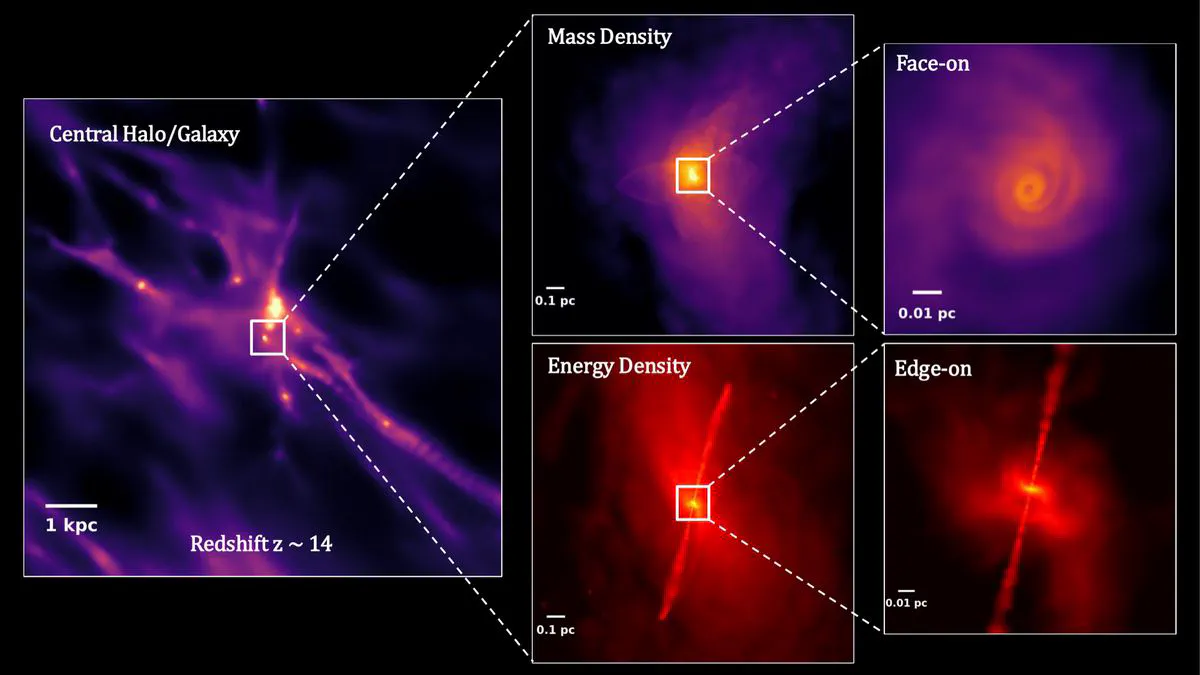 Figure 1. Visualizations of the gas mass and gas kinetic energy surface densities in our cosmological simulation at redshift z ∼ 14. We highlight the dynamic range resolved in our simulation by zooming in from galaxy-wide scales on the left to the scales of the circumstellar disk on the right. In both density plots, the color increases from black to white (different properties use different color schemes) on a logarithmic scale, where each panel uses its own dynamic range. For the mass density plots (differentiated with a black through white color scheme) the median gas surface density (Σmedian) in the top left, top middle, and top right panels are 1.5 × 10⁻¹ M☉ pc−2, 1.7 × 10³ M☉ pc−2, and 2.3 × 10⁴ M☉ pc−2 respectively. For the bottom middle and bottom right panels, we see the bipolar outflows from protostellar jets (in bright red) extend out to ∼1 pc. The top right panel highlights a circumstellar disk extending out to ∼0.01 pc.
