FORGE’d In The Early Universe II: Constraining The Pop III Initial Mass Function
Nov 5, 2026·,,,, ,
Yasmine J. Meziani
Philip F. Hopkins
Pratik J. Gandhi
Claude-André Faucher-Giguère
Michael Y. Grudić
Shivan Khullar
Vasilii Pustovoit
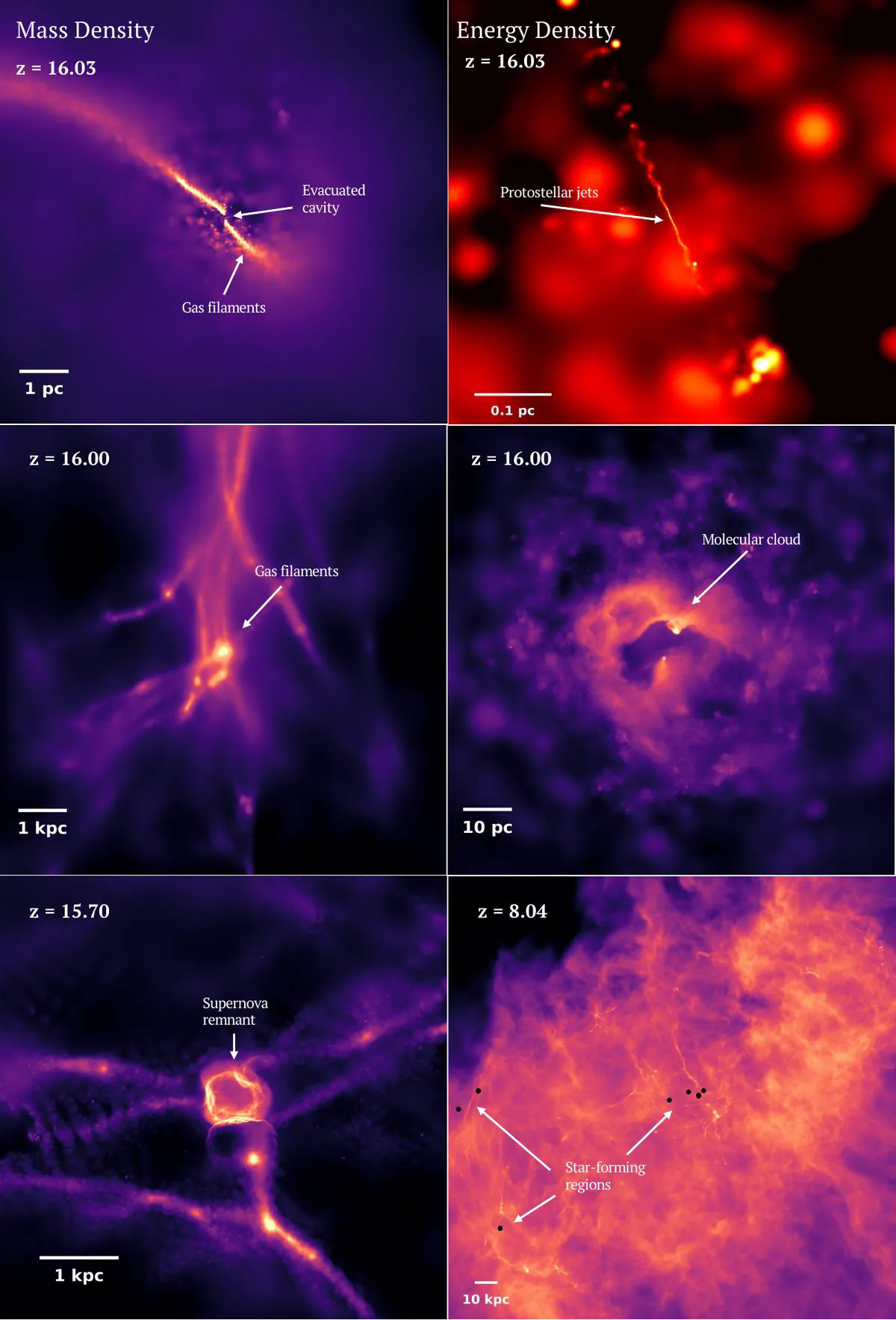 Figure 1. Visualizations of the gas mass and gas kinetic energy surface densities in the cosmological simulation at different redshifts throughout its evolution. Panels shown in purple represent the gas mass surface density, while the top-right panel in red indicates the kinetic energy surface density. Darker colors are regions of lower density, while brighter colors indicate higher density. Multiple panels are used to illustrate different stages of the simulation and to capture its wide dynamic range. The panels show selected regions of the simulation at different spatial scales and evolutionary times. The top-left panel shows a dense gas filament in which stars have formed, with feedback from the newly formed stars evacuating the surrounding gas and producing an evacuated cavity. Star formation occurs along dense gas filaments and within molecular clouds. Protostellar jets are visible before the stars reach the main sequence (top right). The middle-right panel shows a molecular cloud containing filamentary structures on a larger spatial scale. At later times, as the stars evolve and undergo supernovae, supernova remnants appear in the simulation (bottom left). The dots in the bottom-right panel indicate the positions of sink particles.
