The Single-cloud Star Formation Relation

May 1, 2021·
Riwaj Pokhrel
,
Robert A. Gutermuth
,
Mark R. Krumholz
,
Christoph Federrath
,
Mark Heyer
Shivan Khullar
Shivan Khullar
,
S. Thomas Megeath
,
Philip C. Myers
,
Stella S.~R. Offner
,
Judith L. Pipher
,
William J. Fischer
,
Thomas Henning
,
Joseph L. Hora
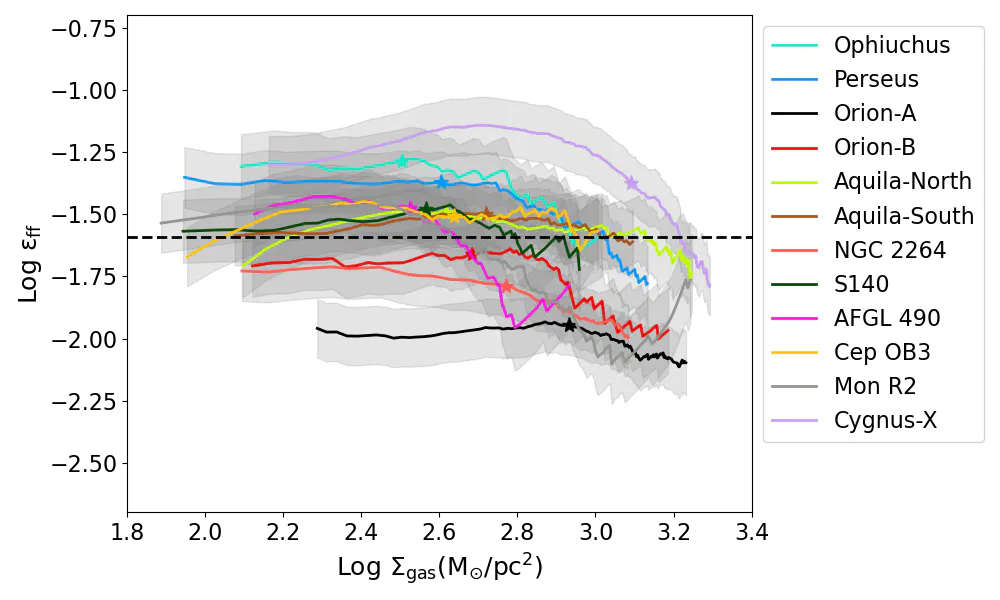
Figure 3. Variation of the free-fall efficiency (εff) with Σgas for our sample of clouds. The shaded regions are the uncertainties in εff which are computed by assuming a Poisson distribution for the number of protostars (Khullar et al. 2019). The stars along the curves for each cloud indicate the column density for which tff ≈ 0.5 Myr. The median of the logarithm of εff (−1.59) is shown by a black dashed line.

Abstract
One of the most important and well-established empirical results in astronomy is the Kennicutt-Schmidt relation between the density of interstellar gas and the rate at which that gas forms stars. A tight correlation between these quantities has long been measured at galactic scales. More recently, using surveys of YSOs, a KS relationship has been found within molecular clouds relating the surface density of star formation to the surface density of gas; however, the scaling of these laws varies significantly from cloud to cloud. In this Letter, we use a recently developed, high-accuracy catalog of young stellar objects from Spitzer combined with high-dynamic-range gas column density maps of twelve nearby (<1.5 kpc) molecular clouds from Herschel to re-examine the KS relation within individual molecular clouds. We find a tight, linear correlation between clouds’ star formation rate per unit area and their gas surface density normalized by the gas free-fall time. The measured intracloud KS relation, which relates star formation rate to the volume density, extends over more than two orders of magnitude within each cloud and is nearly identical in each of the twelve clouds, implying a constant star formation efficiency per free-fall time εff ≈ 0.026. The finding of a universal correlation within individual molecular clouds, including clouds that contain no massive stars or massive stellar feedback, favors models in which star formation is regulated by local processes such as turbulence or stellar feedback such as protostellar outflows, and disfavors models in which star formation is regulated only by galaxy properties or supernova feedback on galactic scales.
Type
Publication
ApJL