FORGE’d in Fragments: Pop III star formation in a Milky Way-like progenitor halo

Nov 5, 2026·
*Vasilii Pustovoit
Shivan Khullar
Shivan Khullar
,
Norman Murray
,
Yasmine J. Meziani
,
Claude-André Faucher-Giguère
,
Philip F. Hopkins
,
Michael Y. Grudić
,
J. Richard Bond
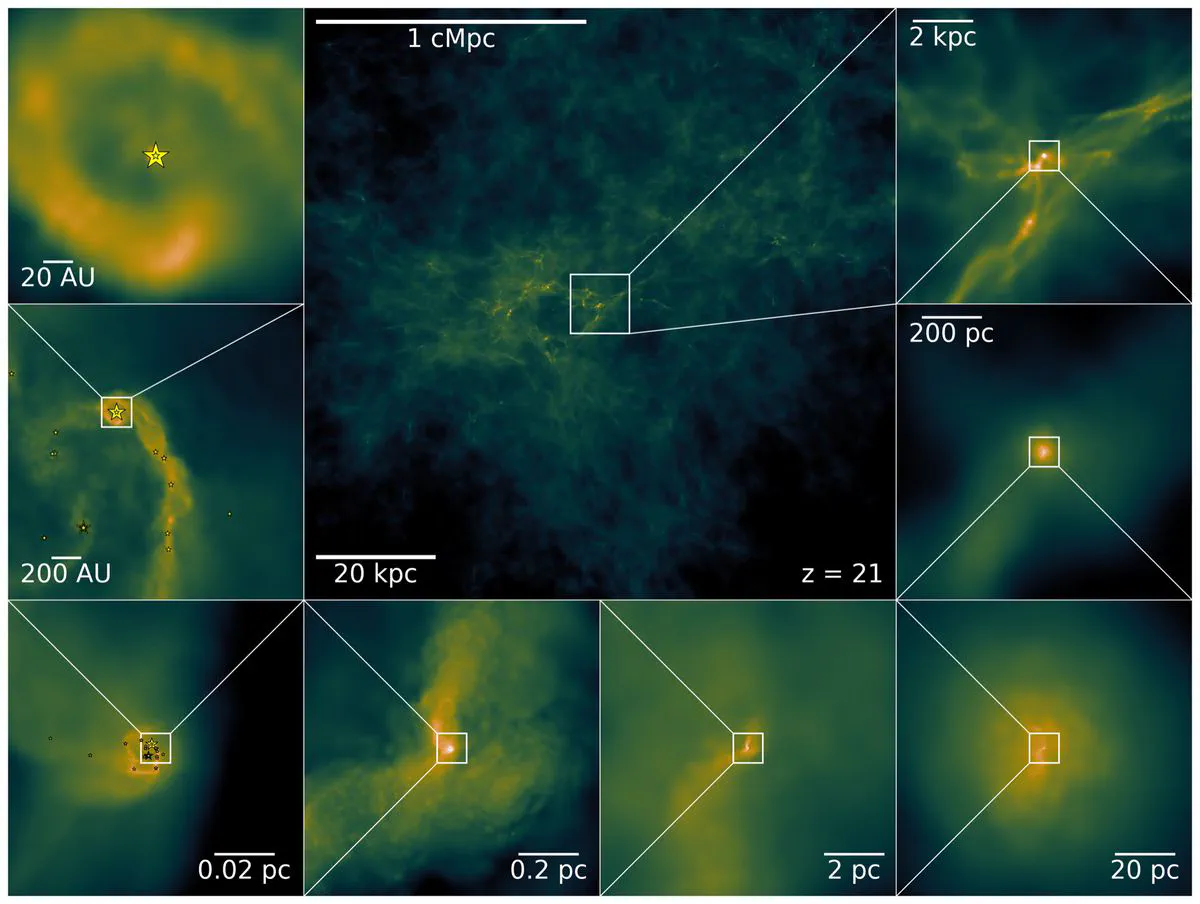
Figure 1. Multi-scale density projection of the simulation at Δt ≈ 15 kyr, illustrating the dynamic range from the cosmic web (box size of ≈100 kpc) to the center of the protostellar disk (resolving AU scales). White boxes mark the region shown in the next panel. Yellow star symbols mark sink particles, with size of the marker scaling with the final mass of the star. The progenitor halo has a dark matter mass of ∼2 × 10⁷ M☉ at the first collapse, z ∼ 21.
Abstract
We present a radiation-magnetohydrodynamic (RMHD) cosmological zoom-in simulation of Pop III star formation, drawing initial conditions from a Milky Way-like progenitor halo at redshift z ∼ 21. We follow the collapse of primordial gas over 10 orders of magnitude, through to the formation of an accretion disk that becomes gravitationally unstable Δt ∼ −3 kyr before the first protostar’s formation. Prominent spiral arms then develop and fragment vigorously, producing ∼60 sink formation events over the first 8 kyr post-collapse evolution, with a total stellar mass reaching >150 M☉ by 15 kyr, the end of our simulation. The disk remains magnetically supercritical throughout: the mass-to-flux ratio falls from μΦ ∼ 102–103 to ∼15 by 15 kyr, as the inflow brings in magnetic flux. The magnetic energy in the disk remains sub-dominant throughout, but grows by ∼3.5 orders of magnitude after the first star forms. The disk starts sub-virial (2Ekin/|Epot| ≈ 0.6) and reaches virial equilibrium within ∼2 kyr. The total stellar mass of the population grows approximately as M⋆ ∝ t2, confirming the prediction of accelerating accretion in self-gravitating turbulent collapse, at rates of Ṁ ∼ 10−3–10−2 M☉ yr−1. The star formation efficiency reaches ≈90% within the disk (after ≈11 kyr; ≈80% at 9.5 kyr) and ∼50% within a 0.1 pc sphere. We find a top heavy IMF (dN/dm ∝ m−α) with a high-mass slope α ≈ 1. The cosmological environment sets the boundary conditions of the disk: an envelope delivers ∼3 × 10⁻³ M☉ yr−1 to the outer edge of a disk with a radius of ∼103 AU; the disk spreads and, in our simulation, its fragmentation sites move outward, from ∼500 to ∼1350 AU, until it has been depleted.
Type
Publication
Submitted to ApJ